
Although ferrosilicon nitride and ferrosilicon have similar names, and ferrosilicon nitride is made from ferrosilicon, there are significant differences between the two in terms of composition, performance, and application. The following is a detailed comparison from three dimensions: core differences, application industries, and usage methods:
1.Core differences (ingredients and performance)
| Ferro Silicon | Nitrided Ferro Silicon | |
| Specification | Si:70-90%C:0.2%maxAl:2%maxS:0.05%maxP:0.05%maxFe:Balance | Si:40-60%Fe:20-40%N:8-14% |
| Physical properties | Silicon and iron form an alloy to form a metal | Silicon nitride (Si₃N₄) hard phase is evenly dispersed in the iron matrix, which is a “ceramic reinforced metal” composite material |
| Performance | – Strong reducing property (silicon easily reacts with oxygen)- Good electrical conductivity- Moderate hardness at room temperature- Easily oxidized at high temperature (severe oxidation above 800℃) | – High wear resistance- High temperature resistance and oxidation resistance (stable below 1300℃, oxidation rate is only 1/5 of ferrosilicon)- Corrosion resistance (resistance to acid, alkali, molten metal erosion)- Low conductivity (due to Si₃N₄ insulation) |
| Preparation process | Silica and iron scraps are directly obtained by reduction smelting in an electric arc furnace | Ferrosilicon is used as raw material, and nitrogen is introduced at high temperature for nitridation reaction to generate Si₃N₄ composite structure. |
2.Differences in application industries
Core application industries of ferrosilicon
The core value of ferrosilicon lies in “strong reducibility” and “alloying function”, which is mainly used in metal smelting
Steel industry (most important):
Steelmaking deoxidizer: improve the purity and mechanical properties of steel.
Alloying element additive: improve the magnetism and elasticity of steel.
Foundry industry:
Inoculant for gray cast iron and ductile iron: improve the strength of castings
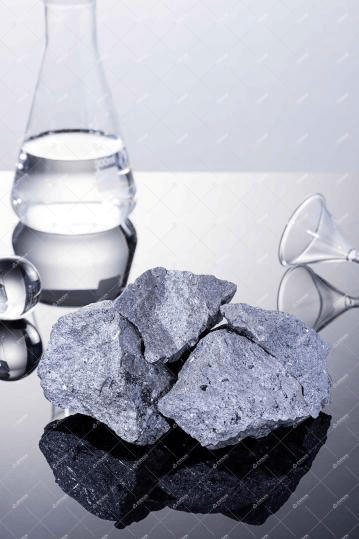
3.Core application industries of Nitrided Ferro Silicon.
The core value of silicon nitride iron lies in its high-temperature wear resistance and corrosion resistance.”
Refractory industry (core):
Blast furnace mud additive: Add 3%-8% to the blast furnace taphole mud, and use Si₃N₄’s resistance to molten iron scouring and high-temperature strength to extend the service life of the mud (from 8-12 hours to 16-24 hours).
Refractory brick enhancer: Improve the oxidation resistance and spalling resistance of refractory bricks.
Foundry industry (high-end scenarios):
Vermicular graphite cast iron inoculant: Improve the thermal fatigue resistance of castings (tensile strength is more than 30% higher than that of ordinary gray cast iron).
Wear-resistant materials industry:
Mixed with iron powder and sintered to form Fe-Si₃N₄ composite wear-resistant parts (such as bearings and liners), used in low-speed and heavy-load scenarios, with wear resistance 2-3 times that of ordinary iron-based parts.

4.Differences in usage
Characteristics of ferrosilicon
- Large dosage, as a basic raw material
- High reactivity
- Low requirements for particle size
Characteristics of ferrosilicon nitride
- Small dosage, as a functional additive
- Need to be retained in the product for a long time
- High requirements for particle size and dispersibility
Ferrosilicon is a “basic raw material for smelting” and serves the production links of steel and casting by its reducing and alloying functions; ferrosilicon nitride is a “high-end functional material” and serves the quality improvement and efficiency increase of high-temperature industries by its wear resistance and high temperature resistance properties of Si₃N₄. The essential difference between the two is that ferrosilicon is a “consumable participating in the reaction” and ferrosilicon nitride is a “reinforcement body that retains the structure.”