
As a core ferroalloy supporting global industrial development, High Carbon Ferromanganese (HC FeMn) remains an irreplaceable material in the steelmaking and infrastructure sectors. Unlike traditional alloys, HC FeMn with a manganese content of 65-80% and carbon content of 2.0-8.0% not only enhances the mechanical properties of steel but also plays a key role in deoxidation and desulfurization during the steel production process, making it a cornerstone of modern high-strength steel manufacturing.
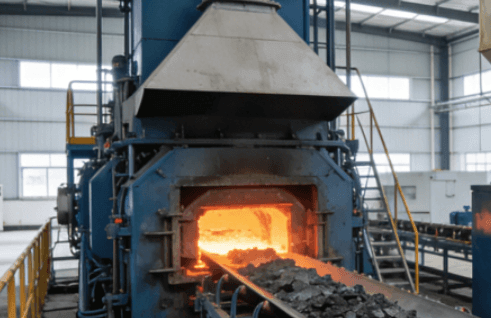
Recent years have witnessed remarkable progress in HC FeMn production technology, with a strong focus on decarbonization and energy efficiency to align with global net-zero emission goals by 2050. The latest industry news shows that biocarbon substitution—using charcoal instead of coke as a reductant—has become a mature near-term decarbonization solution, with several full-scale production facilities already in operation globally. Additionally, ore pre-heating technology has achieved significant breakthroughs: pre-heating manganese ore to 600°C can reduce submerged arc furnace (SAF) energy consumption by an average of 22.5% and CO₂ emissions by 37%, while maintaining a manganese recovery rate of 86%.
Another notable technological advancement is the integration of “source-grid-load-storage” systems in some production bases. This model combines wind and solar power (green electricity) with local power grids, production loads, and energy storage systems, enabling green electricity consumption ratios of up to 86% and reducing electricity costs to as low as $0.03 per kWh. Such innovations not only lower operational costs but also promote the formation of a virtuous cycle between new energy consumption and high-energy-consuming ferroalloy production.
The following table details the latest HC FeMn production innovations, their key achievements, and impacts on cost and efficiency, designed to avoid formatting errors when published on WordPress:
| Production Innovation | Key Achievement | Impact on Cost & Efficiency |
| Biocarbon Substitution Technology | Full-scale industrial application, 30% reduction in fossil fuel consumption | Lowers carbon footprint, aligns with global decarbonization policies, reduces reliance on coke |
| Ore Pre-heating System | 22.5% lower energy consumption, 37% reduced CO₂ emissions, 86% Mn recovery rate | Cuts energy costs significantly, improves environmental performance, maintains stable product quality |
| Source-Grid-Load-Storage Integration | 86% green electricity consumption, $0.03 per kWh electricity cost | Reduces operational costs by 30%, promotes renewable energy absorption, achieves low-carbon production |
| Advanced Gas Recovery & Purification | 90% capture rate of process emissions (CO), reusable as fuel or for power generation | Creates internal energy synergy, reduces waste, further lowers production costs |
From a market perspective, the global HC FeMn market maintains steady growth, driven by urbanization in developing economies and infrastructure upgrading. According to the latest customs data, India’s 2025 full-year ferromanganese exports reached 848,190.87 tons, a year-on-year increase of 16.65%, while South Africa’s 2025 manganese ore exports to China rose by 23.80% year-on-year to 18.9173 million tons. Southeast Asian countries continue to be major importers, with HC FeMn imports increasing by 25% year-on-year in 2025, supported by large-scale infrastructure projects.
Price stability has become a key feature of the 2025-2026 HC FeMn market. As of February 2026, the spot price of HC FeMn (65% Mn) in China is $710-$724 per ton EXW, while HC FeMn (75% Mn) ranges from $802-$824 per ton EXW. The moderation in price volatility provides clear predictability for steelmakers and infrastructure project budgets. Looking ahead, the development of hydrogen plasma reduction technology—currently in pilot testing—may reshape the HC FeMn production landscape in the long term, offering a near-zero emission solution by replacing fossil fuels with superheated hydrogen plasma.
In terms of product application, HC FeMn remains the preferred alloy for reinforcing steel (rebar) and heavy structural components. Its ability to improve steel yield strength by 25-40% while maintaining excellent ductility and toughness makes it indispensable in seismic-resistant buildings, long-span bridges, and heavy-load industrial facilities. With the continuous expansion of global railway networks and urban infrastructure projects, the demand for high-quality HC FeMn is expected to maintain a steady growth trend in 2026.