
In ductile iron production, choosing the right Ferrosilicon Magnesium Nodulizer size directly affects magnesium recovery, spheroidization performance, and casting quality.
Among different specifications, 5-15mm nodulizer and 20mm nodulizer are the most commonly used in foundries and iron casting plants.
Understanding their differences can help foundries improve treatment efficiency, reduce magnesium fading, and achieve stable ductile iron production.
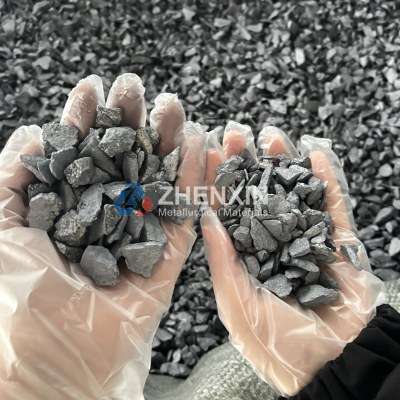
What Is Ferrosilicon Magnesium Nodulizer?
Ferrosilicon Magnesium Nodulizer, also known as FeSiMg alloy or magnesium ferro silicon alloy, is widely used in ductile iron manufacturing.
It helps transform graphite from flake form into spheroidal graphite, improving:
- Tensile strength
- Elongation
- Impact resistance
- Casting performance
5-15mm Ferrosilicon Magnesium Nodulizer
The 5-15mm size is one of the most popular specifications for medium and small ductile iron foundries.
Because of its smaller particle size, it reacts faster during molten iron treatment and provides stable magnesium absorption.
Advantages of 5-15mm Nodulizer
- Faster reaction speed
- Better alloy distribution
- Suitable for automatic feeding systems
- Lower residual magnesium fluctuation
- Good for small and medium ladles
Typical Applications
- Ductile iron pipe production
- Automotive castings
- Precision iron castings
- Small tonnage iron treatment
20mm Ferrosilicon Magnesium Nodulizer
20mm nodulizer is usually preferred for larger molten iron capacity and heavy casting production.
Its larger size slows the reaction rate and helps reduce violent magnesium reaction during treatment.
Advantages of 20mm Nodulizer
- More stable reaction process
- Reduced magnesium splash
- Suitable for high-temperature molten iron
- Better for large ladles and heavy castings
- Lower burning loss in some applications
Typical Applications
- Large ductile iron foundries
- Heavy machinery castings
- Wind power castings
- Large pipe fittings production
5-15mm vs 20mm Nodulizer: Key Differences
| Specification | 5-15mm Nodulizer | 20mm Nodulizer |
| Reaction Speed | Faster | Slower |
| Magnesium Recovery | Stable | Stable for large volume |
| Suitable Furnace Size | Small & medium | Large |
| Treatment Process | Rapid | Controlled |
| Casting Type | Precision castings | Heavy castings |
| Splash Control | Moderate | Better |
Choosing the correct size depends on:
- Molten iron capacity
- Treatment temperature
- Casting type
- Process stability requirements
How to Choose the Right FeSiMg Nodulizer Supplier
A reliable Ferrosilicon Magnesium supplier should provide:
- Stable magnesium composition
- Low impurities (P, S, Ti)
- Consistent particle sizing
- Strong packaging protection
- Stable long-term supply
Many foundries face problems such as:
- Unstable spheroidization
- Excessive slag generation
- Inconsistent magnesium recovery
- Irregular sizing distribution
Working with an experienced nodulizer manufacturer helps reduce production risks and improve casting consistency.
Conclusion
Both 5-15mm and 20mm Ferrosilicon Magnesium Nodulizer have important roles in ductile iron production.
The right specification depends on your treatment process, casting size, and molten iron capacity.
For foundries seeking stable magnesium recovery, low impurities, and consistent spheroidization performance, choosing a professional FeSiMg nodulizer supplier is just as important as choosing the right particle size.