
Ferrochrome nitride, also commonly referred to as nitrided ferro chrome, is a vital ferroalloy material primarily composed of key nitrides including CrN, Cr₂N, and Fe₄N. In some production processes, it can also form ferrochrome composite nitrides (Cr, Fe)₂N(1-x), where the phase composition is mainly influenced by the nitriding medium and reaction temperature. As a critical raw material in special steel production, it is widely recognized for its role in manufacturing corrosion-resistant and other high-performance nitrogen-containing steels.
Key Features of Ferrochrome Nitride
Ferrochrome nitride boasts a range of superior characteristics that make it indispensable in metallurgical applications:
Stable nitrogen content ensures consistent performance in steel smelting, avoiding fluctuations that could affect product quality. Its high density enhances its durability and compatibility with other alloy materials, while the high alloy absorption rate maximizes its utilization efficiency in the smelting process. With a melting point of approximately 700 degrees Celsius, it adapts well to various smelting conditions. Importantly, it can partially replace nickel, a precious metal, significantly reducing production costs for steel manufacturers without compromising product performance.
Chemical Composition of Ferrochrome Nitride
Ferrochrome nitride has standardized chemical compositions to meet different industrial needs, with both standard and non-standard specifications available:
| Chemical Formula | Cr Min | N Min | C Max | Si Max | P Max | S Max |
| FeNCr3-A | 60% | 3.0% | 0.03% | 1.5% | 0.03% | 0.04% |
| FeNCr3-B | 60% | 5.0% | 0.03% | 2.5% | 0.03% | 0.04% |
| FeNCr6-A | 60% | 3.0% | 0.06% | 1.5% | 0.03% | 0.04% |
| FeNCr6-B | 60% | 5.0% | 0.06% | 2.5% | 0.03% | 0.04% |
| FeNCr10-A | 60% | 3.0% | 0.10% | 1.5% | 0.03% | 0.04% |
| FeNCr10-B | 60% | 5.0% | 0.10% | 2.5% | 0.03% | 0.04% |
In addition to the standard compositions above, there are other non-standard specifications to meet specific customer requirements:
1. Cr 60-65% min, N 8-10%, C 0.1%, Si 1.5-2.5%, P 0.03% max, S 0.04% max
2. Cr 60-65% min, N 8-10%, C 0.06%, Si 1.5-2.5%, P 0.03% max, S 0.04% max
3. Cr 60-65% min, N 8-10%, C 0.03%, Si 1.0% max, P 0.03% max, S 0.04% max
Production and Delivery Standards
Production Standard
Sampling and sample preparation for ferrochrome nitride are conducted in accordance with the standard methods for ferrochrome. Class A products are suitable for seed fusion products after nitriding, and their nitrogen content does not include adsorbed nitrogen. Class B products are applicable to fixed nitriding alloys. For each furnace batch, the contents of chromium, nitrogen, phosphorus, carbon, and sulfur must be tested and verified. Upon negotiation between suppliers and buyers, Class B products with a silicon content not exceeding 3.0% can be supplied. For special requirements on chemical composition, both parties shall reach an agreement through negotiation.
Delivery Standard
| Item | Specifications |
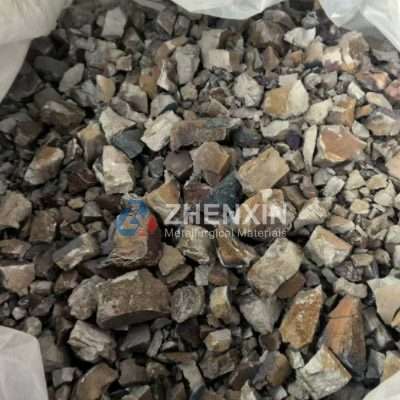
| Natural Property | Ferrochrome nitride is delivered in blocks, with each block weighing no more than 5kg. The quantity of high-nitrogen ferrochromium blocks smaller than 10mm×10mm shall not exceed 10% of the total weight. |
| Physical Condition | The interior and surface of ferrochrome nitride shall be free of significant non-metallic inclusions. The surface and interior of solid nitriding alloys shall not show obvious molten states. |
| Packing | It can be packed in bulk or ton bags according to the buyer’s requirements. |
| Specialties | Special requirements from buyers can be negotiated with suppliers. |
Preparation of Nitrided Low Carbon Ferrochrome
In China, the standard nitrogen content of ferrochrome nitride products ranges from 3.0% to 5.0%. In the production of nitrogen-containing steel, vacuum resistance furnaces are commonly used with the solid nitriding production process. Solid-phase nitriding uses nitrogen or ammonia as the nitriding raw material, and the nitriding reaction takes place in a vacuum induction furnace or resistance furnace. This method is generally combined with vacuum smelting of ferrochrome; after vacuum decarburization is completed, nitrogen is introduced into the vacuum furnace or induction furnace for nitriding treatment.
Ferrochrome nitride produced by this method has high porosity. Remelting the ferrochrome nitride can densify the alloy, but the nitrogen content will decrease by 2% to 2.5% during the remelting stage. Another practical preparation method is Self-propagating High-Temperature Synthesis (SHS), which serves as an alternative to the vacuum heating method for producing high-purity, high-strength, and corrosion-resistant ferrochrome nitride. The core feature of SHS is utilizing the high heat generated by chemical reactions between elements to synthesize high-melting, high-performance materials in a short time. This technology integrates material synthesis and sintering, with the formation of a combustion structure during the reaction process, and the macro-dynamics of the structure connects the combustion process and structure formation.
The self-propagating high-temperature combustion process is divided into four stages: rapid expansion of the combustion reaction zone, steady-state combustion stage, deceleration synthesis stage, and post-combustion stage after the combustion wave passes.
Applications of Ferrochrome Nitride
Ferrochrome nitride is widely used in electric furnaces and oxygen converters for smelting nitrogen-bearing steel. As a key alloy material, it plays an irreplaceable role in the smelting and production of special steels such as stainless steel, heat-resistant steel, corrosion-resistant steel, and alloy steel. Nitrogen, as an austenite-forming element, is added as a component in chromium-manganese and chromium-manganese-nickel stainless steel to make up for the shortage of nickel.
Research indicates that the effect of nitrogen in expanding the austenite region is approximately 30 times that of nickel. Currently, adding nitrogen to the production of nickel-containing austenitic stainless steel can partially replace the precious metal nickel, bringing substantial economic benefits to manufacturers. Additionally, nitrogen can enhance the steel’s strength and corrosion resistance while maintaining good plasticity.
2026 Ferrochrome Nitride Industry News
The global ferrochrome nitride industry is experiencing steady growth driven by the expanding demand for special steel. According to the latest industry research, the global ferrochrome market is expected to reach $208.4 billion by 2032, with a compound annual growth rate (CAGR) of 4.0% from 2026 to 2032. In 2026, the supply structure of the high-chromium market is showing a trend of internal growth and external decline, with domestic production capacity continuing to expand to meet the growing demand.
A notable trend in 2026 is the increasing demand for ferrochrome nitride driven by the AI and new energy sectors. The wave of AI data center construction has led to a surge in demand for gas turbines, where chromium is a core component of high-temperature alloys. At the same time, the rapid expansion of solid oxide fuel cells (SOFC) and iron-chromium flow batteries is expected to bring an additional demand of over 10,000 tons for the chromium market in 2026, promoting the transformation of chromium from an “industrial auxiliary material” to a “value-driven material”.
In terms of technology, the optimization of self-propagating high-temperature synthesis (SHS) technology is advancing, with continuous improvements in raw material ratio and reaction parameters, enabling the production of higher-purity ferrochrome nitride with better performance. This technological progress is helping to reduce production costs and improve the market competitiveness of ferrochrome nitride products.