
Ferrophosphorus, often referred to as ferro phosphorus alloy, is a vital iron-based alloy composed primarily of phosphorus and iron. Beyond its core components, it naturally contains trace impurities such as silicon, manganese, carbon, and sulfur, whose content varies slightly based on production methods and raw material quality. As a key auxiliary material in the metallurgical and chemical industries, ferrophosphorus plays an irreplaceable role in multiple industrial fields, with its application scope expanding alongside the upgrading of related industries.
Against the backdrop of the global phosphorus chemical industry’s “super cycle” in 2025-2026, ferrophosphorus, as an important downstream product of phosphorus resources, has also been affected by the industry’s structural changes. With the increasing strategic status of phosphorus resources—marked by the U.S. listing phosphorus as a national defense priority in early 2026—the supply chain of ferrophosphorus has been further optimized, and its market demand has shown a steady growth trend. Meanwhile, the tight supply of upstream phosphate rock and the rising price of raw materials have promoted the upgrading of ferrophosphorus production technology, with more enterprises focusing on improving product purity and reducing impurity content to enhance market competitiveness.
In 2025, the global ferrophosphorus market was driven by the dual growth of traditional industries and new energy demand. The steelmaking and casting industries, as the main consumption areas, maintained stable demand, while the emerging application in the coating industry—using ultra-fine ferrophosphorus powder to replace ultra-fine zinc powder—has become a new growth point. It is expected that in 2026, with the continuous expansion of the new energy storage industry, the demand for ferrophosphorus in related fields will further increase, driving the overall market scale to continue to grow.
Basic Properties of Ferrophosphorus
Appearance: Ferrophosphorus presents a black-red or dark brown appearance, with a dense texture and no obvious luster. The specific color may vary slightly depending on the phosphorus content and impurity composition.
Chemical Composition: The core components are phosphorus and iron, with impurities including silicon, manganese, carbon, sulfur, and titanium (in some grades). The content of these impurities is strictly controlled to meet different industrial application requirements.
Physical Indicators: For ferrophosphorus with a phosphorus content of 18%-25%, the melting temperature ranges from 1100℃ to 1250℃, and the density is between 5.8g/cm³ and 6.5g/cm³. These indicators determine its adaptability in high-temperature smelting scenarios.
Chemical Content and Specifications of Ferrophosphorus
The following table details the standard specifications of ferrophosphorus, which are formulated in line with industry standards and can be customized according to customer needs to adapt to different application scenarios.
| Grade | P% | Si% | Mn% | Ti% | S% | C% |
| Ferro Phosphorus | 23.0 | 3.0 | 2.5 | – | – | – |
| Low Ti Ferro Phosphorus | 23.0 | 1.0 | 1.5 | 0.5 | 0.20 | 0.20 |
| High P Ferro Phosphorus | 26-28 | 1.0 | 2.0 | 2.0 | 0.01 | 0.01 |
| High pure Ferro Phosphorus | 23-27 | 1.5 | 1.0 | 1.5 | 0.05 | 0.05 |
Common Forms of Ferrophosphorus
Ferrophosphorus is available in multiple forms to meet the diverse needs of different industries, and all forms can be customized according to customer requirements:
Ferrophosphorus Natural Block: Irregular block shape, with no fixed size, can be processed according to customer-specific size and weight requirements.
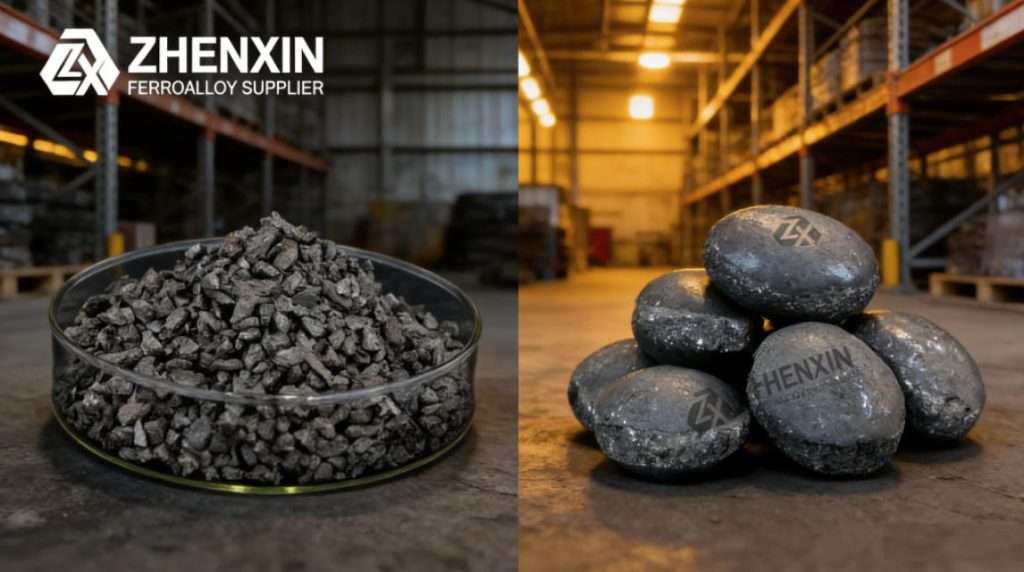
Ferrophosphorus Powder: The particle size ranges from 500 mesh to 1200 mesh, with fine and uniform particles, suitable for application scenarios such as coatings and precision casting.
Ferrophosphorus Particles: The particle size is 0-2mm, with uniform particle size distribution, which is convenient for quantitative addition in smelting processes.
Ferrophosphorus Ball: The standard diameter is 30mm and 40mm, with high density and uniform composition, which can improve the utilization rate in smelting and reduce waste.
Production Process of Ferrophosphorus
There are three main production methods of ferrophosphorus in the industry: electric furnace method, converter method, and blast furnace method. Among them, the electric furnace method is the most widely used due to its stable product quality and controllable process. The specific production process is as follows:
Raw Material Preparation: Select high-quality phosphate rock, iron ore, coke and other raw materials, and strictly proportion them according to the product specifications to ensure the stability of the final product components.
Smelting Process: Add the proportioned raw materials into the electric furnace, and raise the temperature to above 1400℃. Under high-temperature conditions, the phosphorus in the phosphate rock is reduced and synthesized with iron to form ferrophosphorus alloy.
Refining and Tapping: After sufficient smelting, impurities and harmful gases in the molten iron are removed through refining operations. After the components meet the standard, the molten ferrophosphorus is tapped and cooled to form the final product.
Applications of Ferrophosphorus
Steelmaking Industry: As an important alloying agent, an appropriate amount of ferrophosphorus added to steel can effectively improve the strength, corrosion resistance and machinability of steel, and reduce the brittleness of steel, which is widely used in the production of high-strength steel and corrosion-resistant steel.
Casting Industry: Adding ferrophosphorus to molten iron can improve the fluidity of molten iron, make the casting form more full, reduce the defects such as shrinkage and porosity of castings, and thus improve the performance and surface quality of castings.
Coating Industry: Ferrophosphorus with a phosphorus content of 20% can be ground into ultra-fine powder, which can replace ultra-fine zinc powder in coatings, reducing production costs while ensuring the anti-corrosion performance of coatings. In addition, it also has a certain radiation protection function, which can be applied to special coating fields.
Product Supply and Related Information
Packaging: Adopt 1 MT big bag packaging, which is convenient for transportation and storage. It can also be packaged according to customer special requirements to meet the needs of different transportation methods.
Size: The standard size is 10-60mm, and the size can be adjusted according to customer application scenarios and smelting requirements.
Delivery Time: The delivery time is 7-14 days after the order is confirmed, ensuring that the product is delivered to the customer on time and meeting the customer’s production schedule.
MOQ: The minimum order quantity is 20MT, which is suitable for both large-scale production enterprises and small and medium-sized enterprises with batch demand.