
Industry Overview: Core Changes in the Ferrophosphorus Market in 2025
The global Ferrophosphorus industry has undergone significant structural adjustments in 2025, with the upgrading of environmental policies and the transformation of downstream demand becoming the core driving factors. Data shows that the proportion of production capacity adopting environmentally friendly smelting processes in global high-phosphorus pig iron production capacity has increased to 41%, an increase of nearly 20 percentage points compared with 2020. At the same time, the downstream demand structure has undergone a fundamental transformation. The demand for traditional automotive iron castings has shrunk, while the purchase volume of Ferrophosphorus for wind power equipment castings and UHV power grid towers has increased by 18% and 23% year-on-year respectively, becoming the main driving force for industry growth. In terms of international standards, ISO is revising the titration detection standard for phosphorus content (ISO/CD 2599). The new standard will further standardize the quality inspection process of Ferrophosphorus products and is expected to be officially released and implemented in 2026.
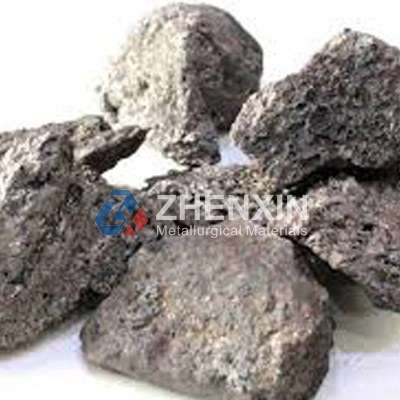
Core Definition and Characteristics of Ferrophosphorus
Ferrophosphorus, also known as phosphorus-iron alloy, is a ferroalloy mainly composed of phosphorus and iron. In addition to the core elements, it also contains trace impurities such as silicon, manganese, carbon, and sulfur. Different from traditional cognition, modern Ferrophosphorus production can accurately control impurity content at an extremely low level through process optimization to meet the needs of high-end industrial fields. Its core characteristics are as follows:
Appearance Characteristics: Ferrophosphorus appears black-red or dark brown. The product form can be adjusted according to application scenarios, and the surface texture shows different compactness affected by the production process.
Physical Properties: For Ferrophosphorus with a phosphorus content of 18%-25%, the melting temperature ranges from 1100℃ to 1250℃, and the density is maintained between 5.8g/cm³ and 6.5g/cm³, which has good high-temperature stability and is suitable for use as a high-temperature alloy additive.
Chemical Characteristics: The combination of phosphorus and iron can significantly improve the corrosion resistance and mechanical strength of the alloy. At the same time, its good fluidity can improve the forming effect of castings, which is the core reason for its wide application in the casting industry.
Chemical Specifications and Testing Standards of Ferrophosphorus in 2025
With the continuous improvement of industry standards, the chemical content control of Ferrophosphorus products has become more stringent in 2025. The following are the current mainstream product specification standards, and all indicators comply with the latest industry norms:
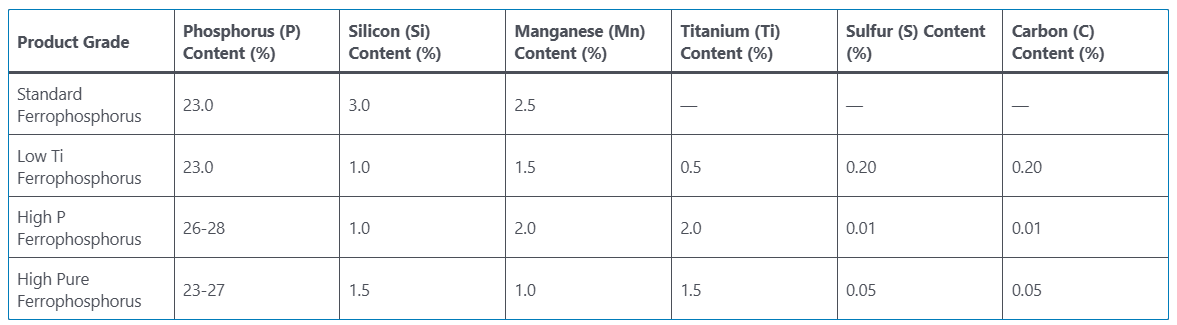
Note: The above specifications can be customized according to customer’s actual needs, and the testing method is implemented with reference to the ISO/CD 2599 (2025 revised version) titration standard.
Main Product Forms and Application Scenarios of Ferrophosphorus
In 2025, the product form of Ferrophosphorus shows a diversified development trend. Different forms of products form precise matching for different application scenarios. The following are the current mainstream product forms and core applications in the market:
Ferrophosphorus Natural Block: Mainly used as an alloy additive in the steelmaking industry. The block size can be customized according to customer needs. The weight of a single block is usually not more than 20KG, which is convenient for precise feeding during the smelting process.
Ferrophosphorus Powder: The particle size range is 500-1200 mesh, which can be customized. In 2025, its application field has achieved new breakthroughs. Ultra-fine Ferrophosphorus powder with a phosphorus content of about 20% can replace ultra-fine zinc powder in the coating industry, and the application research in the field of new energy battery materials has also made progress.
Ferrophosphorus Particles: The particle size is 0-2mm, mainly used in the casting industry. It can improve the fluidity of molten iron, improve the surface quality and internal performance of castings, and is especially suitable for the production of large wind power equipment castings.
Ferrophosphorus Ball: The conventional diameter is 30mm and 40mm, and the size can be customized. It has the characteristics of convenient feeding and sufficient reaction, and the application demand in the production of UHV power grid tower castings has increased significantly.
(Image Suggestion: Physical comparison chart of four product forms, marked with corresponding application scenarios, placed at the end of this section)
Ferrophosphorus Production Process Upgrade and Environmental Innovation
In 2025, the Ferrophosphorus production process has undergone major upgrades. Environmental protection technology and production efficiency improvement have become the core competitiveness of the industry. The current mainstream production methods include converter method, blast furnace method and electric furnace method. Among them, the electric furnace method has become the dominant production capacity due to its superior environmental performance and high product purity. Its core production process is as follows:
Raw Material Pretreatment: Select phosphate rock, iron ore, coke and other raw materials, remove impurities through precise proportioning and pretreatment, and ensure that the raw material purity meets the smelting requirements. In 2025, the industry generally adopts intelligent proportioning systems, and the raw material utilization rate has increased to more than 88%.
High-Temperature Smelting: Send the pretreated raw materials into the electric furnace, heat up to above 1400℃, realize the reduction of phosphorus in phosphate rock through oxygen-enriched smelting reduction technology, and synthesize Ferrophosphorus alloy with iron. This technology can reduce energy consumption by about 18% and reduce pollutant emissions by 30%.
Refining and Forming: After full smelting, remove impurities and gases in the alloy through external refining technology, and then perform casting, crushing or pulverizing treatment according to the product form requirements to finally form qualified products.
It is worth noting that industry environmental protection standards have been further tightened in 2025, and the environmental protection cost per ton of products has increased by 80-120 yuan, forcing enterprises to upgrade waste gas treatment and water resource recycling systems. At present, the water reuse rate of advanced production lines has exceeded 95%.
New Application Trends of Ferrophosphorus Industry (2025)
With the transformation and upgrading of downstream industries, the application fields of Ferrophosphorus have been continuously expanded in 2025. In addition to the traditional iron and steel and casting industries, the application demand in new energy, environmental protection and other fields has grown rapidly:
Iron and Steel Industry: As a core alloy agent, adding an appropriate amount of Ferrophosphorus can improve the strength, corrosion resistance and cutting performance of steel, especially widely used in the production of high-strength steel. Driven by UHV construction in 2025, the demand for high-strength steel for power grids has increased, driving the consumption of Ferrophosphorus to increase by 23% year-on-year.
Casting Industry: Ferrophosphorus can significantly improve the fluidity of molten iron, reduce casting defects such as shrinkage cavities and cracks, and improve the surface quality and mechanical properties of castings. The application demand in wind power equipment large castings, construction machinery castings and other fields has increased significantly, with a year-on-year growth of 18% in 2025.
Coating and New Energy Fields: Ultra-fine Ferrophosphorus powder can replace ultra-fine zinc powder for anti-corrosion coatings, which can reduce production costs while ensuring anti-corrosion effects; in the new energy field, Ferrophosphorus, as an important raw material for iron phosphate production, driven by the growth of lithium iron phosphate battery demand, the demand increment in 2025 reached 1 million tons/year.
Other Fields: In the field of radiation protection, Ferrophosphorus can be used to manufacture radiation protection materials due to its special physical properties, and the application in this field is in the stage of rapid expansion.
Product Packaging, Delivery and Order Information
To ensure stable product quality and convenient transportation, the products adopt standardized packaging and efficient delivery processes:
Packaging Specification: 1-ton big bag packaging is adopted, and the packaging method can be customized according to customer needs to ensure no leakage and no loss during transportation.
Size Range: The size of conventional products is 10-60mm, and other sizes can be customized and processed according to customer production needs.
Delivery Cycle: Delivery will be completed within 7-14 working days after order confirmation, and urgent production can be coordinated according to customer’s urgent needs.
Minimum Order Quantity (MOQ): 20MT, long-term cooperation for bulk orders is supported, and more competitive price policies are available for bulk purchases.