
The storage of ferromanganese must be combined with its chemical properties (easy to oxidize, moisture absorption) and physical form (lump, granular) to prevent quality deterioration and ensure safety. The following are the core standards and requirements for ferromanganese storage:
Storage environment requirements
1.Moisture and humidity control
Humidity control: The relative humidity of the storage place should be ≤60% (ideally ≤50%), and avoid open-air stacking or contact with rain and condensation. A humid environment will cause the surface of ferromanganese to oxidize and rust (generating oxides such as MnO₂), and even react with moisture to produce trace amounts of hydrogen (high-carbon ferromanganese is more likely to absorb moisture when the carbon content is high), affecting the stability of the components.
Ground treatment: The storage floor needs to be hardened and dry, and moisture-proof mats (such as wooden boards, plastic films) can be laid or raised for storage (≥30cm from the ground) to prevent ground moisture erosion.
2.Anti-oxidation and sealing
Isolation from air: Manganese is easy to react with oxygen at room temperature to form an oxide film. Long-term exposure will lead to a decrease in manganese content and an increase in impurities. For high-purity or low-carbon ferromanganese, it is recommended to store it in a sealed warehouse or cover it with waterproof canvas or plastic film, and fill it with inert gas (such as nitrogen) for protection when necessary.
Packaging requirements: Bulk ferromanganese (lump) can be sealed in ton bags, iron drums or containers; Granular or powdered ferromanganese needs to be packaged in moisture-proof paper bags or plastic woven bags, and the bag openings must be tightly sealed to prevent air from entering.
3.Temperature and ventilation
Temperature range: The storage environment temperature should be controlled at -20℃~40℃, avoiding extreme high temperatures (such as near heat sources or exposure to the sun in summer), which will accelerate oxidation reactions.
Ventilation conditions: The warehouse needs to be well ventilated to prevent the accumulation of humid air, but strong winds should be avoided to cause dust to fly (granular ferromanganese needs to be dustproof).

Storage requirements for different types of ferromanganese
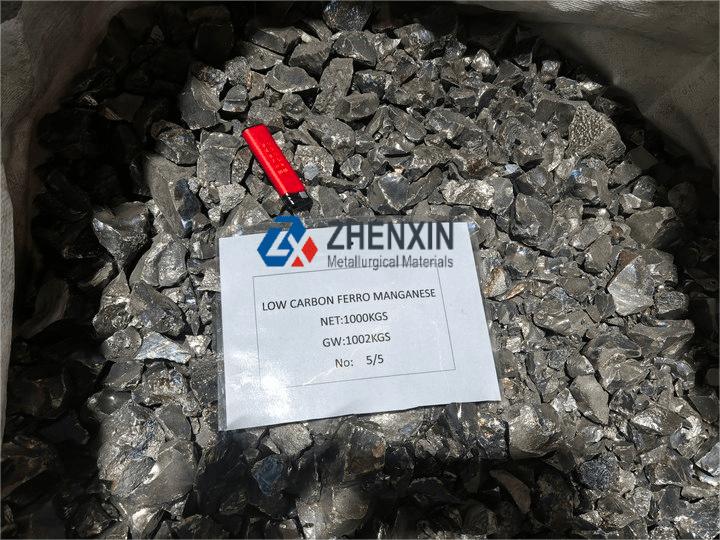
1.Low-carbon ferromanganese and micro-carbon ferromanganese
Due to its extremely low carbon content (≤0.7%), it is more sensitive to oxidation. It is recommended to store it in a vacuum package or inert gas protected container, with a storage environment humidity of ≤40%, and avoid contact with air for more than 24 hours.
2.Refined ferromanganese (high purity)
For special steel grades (such as stainless steel and precision alloys), impurities (such as P and S) must be strictly controlled. It must be isolated from ordinary ferromanganese during storage to avoid cross contamination. Food-grade or industrial-grade high-purity plastic bags must be used for packaging materials.
Storage period and turnover management
Recommended storage period: ordinary ferromanganese should not be stored for more than 12 months, and low-carbon/micro-carbon ferromanganese should not be stored for more than 6 months. It must be retested and qualified after exceeding the period before it can be used.
First-in-first-out principle: ferromanganese stored earlier should be used first according to the batch of storage to avoid long-term backlog and quality degradation.
Summary
The core of ferromanganese storage is “moisture-proof, anti-oxidation, and classified management”. By controlling environmental humidity, isolating air, standardizing stacking and safety protection, its chemical composition and physical properties can be effectively maintained stable to ensure its normal role in steel smelting. Ferromanganese with different carbon content and purity needs to adjust the storage plan according to its characteristics to meet the quality requirements of industrial production.